A useful comparison therefore starts with the intended problem, the exact formulation studied, the amount of curcuminoids disclosed and the risks for the person considering it. It does not start with a percentage absorption claim or a numerical score.
This guide compares types of labels and evidence. It does not report laboratory testing, certify product quality or recommend a winning brand.
Turmeric, curcumin and curcuminoids are not the same label claim
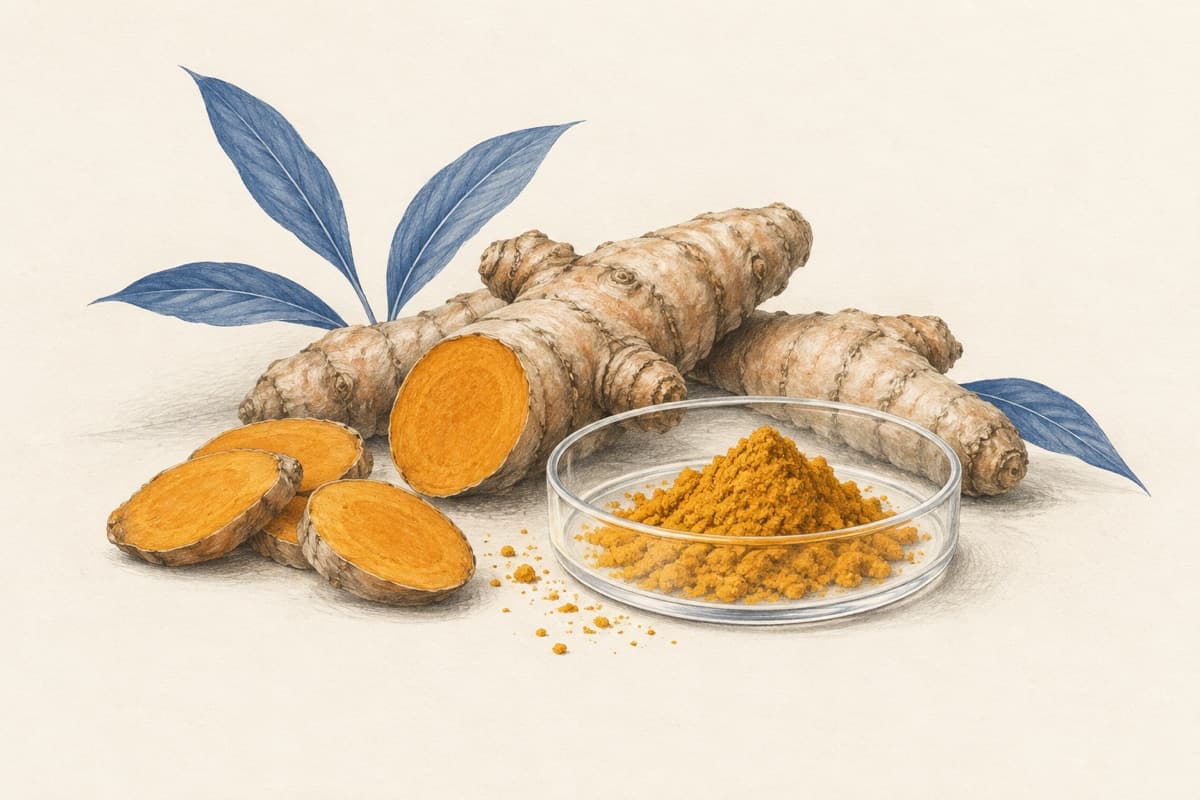
Turmeric is the plant ingredient commonly used as a spice. Curcumin is one of its components; curcuminoids is a broader group that includes curcumin. A gram of turmeric root powder is not the same as a gram of a concentrated curcuminoid extract.[1]
That distinction changes the comparison. A front label stating “turmeric 1,000 mg” may describe plant powder, an extract, a mixture, or an equivalent amount calculated from an extraction ratio. None of those possibilities establishes the quantity of curcumin delivered. Read the actual ingredient declaration before comparing bottles.
Compare formulations without inventing a winner
| Label description | Information to request or locate | What it does not prove |
|---|---|---|
| Turmeric root powder | Plant part, amount per serving and whether an extract is also included. | Equivalence to the concentrated preparation used in a clinical trial. |
| Standardized curcuminoid extract | Extract amount, stated percentage or milligrams of curcuminoids, and serving size. | That the entire extract weight is curcumin, or that a larger number produces a better outcome. |
| Curcumin with piperine or black pepper extract | Separate amounts of curcuminoids and piperine; all additional ingredients. | That an absorption result is a pain-relief result, or that the combination is appropriate with your medicines.[1] |
| Phytosome, micellar, liposomal or another delivery system | Exact formulation identity; whether the stated weight describes the full complex or the curcuminoids; a link to its human study. | That every product using the same delivery-system term has the same composition or clinical evidence. |
| A multi-ingredient joint or “inflammation” blend | Amount of each active ingredient and evidence for the complete formulation. | That evidence for one isolated ingredient validates the combination. |
The last column is important: a comparison can identify what is disclosed without pretending to know which formulation works best. Where the label leaves a question unanswered, record “not disclosed,” not an estimated score.
What a human knee study can—and cannot—tell us
A 2020 randomized trial assigned 70 adults with symptomatic knee osteoarthritis and ultrasound-detected effusion-synovitis to a particular Curcuma longa extract or placebo for 12 weeks. Pain improved more in the extract group, but the study did not show improvement in effusion-synovitis volume or cartilage composition. It was small, short and conducted at one center; funding included the extract manufacturer.[2]
This supports a narrow statement: a particular preparation showed a symptom signal in a particular population. It does not establish cartilage regeneration, prevention of arthritis, or superiority of a delivery-system class. It also does not demonstrate that an unspecified turmeric capsule on a store shelf will reproduce the result.
When a product cites a study, check the connection rather than counting citations. Does the study use the same ingredient and formulation? Were participants dealing with the same problem? Was there a placebo or active comparator? Was the outcome a symptom meaningful to patients, a laboratory marker, or just the concentration of a compound in blood? A well-referenced marketing page can still answer a different question from yours.
Why “better absorbed” is an incomplete buying argument
Absorption studies concern how a substance or its metabolites enter circulation under study conditions. A clinical-benefit claim concerns what happens to people: less pain, easier movement or another specified outcome. Those are different endpoints.
For a claim that one formulation is clinically better, ask for a head-to-head human trial using relevant outcomes and appropriate doses — not merely separate studies conducted in different populations. A chart comparing blood concentrations should not be relabeled as a chart comparing pain relief.
Higher exposure is not automatically safer
The DILIN investigators reported ten adjudicated cases of turmeric-associated liver injury, including hospitalizations and one death. Some tested products also contained piperine. A case series identifies a safety signal; it cannot estimate the risk among all users or prove that piperine caused the injuries.[3]
A practical label-reading worksheet
Identify what the amount describes
Copy the ingredient name exactly. Then record three separate fields: total extract or complex weight, declared curcuminoid content, and number of capsules in one serving. Keeping them separate prevents an apparent milligram comparison from becoming a false equivalence.
Illustrative label arithmetic—not a product assessment or a dose recommendation: an extract listed as 500 mg and standardized to 95% curcuminoids would declare 475 mg curcuminoids if the statement applies to that extract. A different label saying “500 mg curcumin complex” without its curcuminoid content does not provide enough information for the same calculation. Do not assume the second product contains 500 mg curcuminoids.
Even a correct calculation does not verify what is actually in the bottle. That requires appropriate quality evidence, not arithmetic.
Separate the daily serving from one capsule
A bottle containing 60 capsules is not necessarily a 60-day supply. Read how many capsules make the labeled serving and how often the directions propose taking it. Compare costs using the same clearly defined unit.
Do not calculate a “cost per effective milligram” across dissimilar formulations. There is no universal curcumin dose-response conversion that turns different delivery systems into comparable clinical outcomes. A lower cost per labeled serving may matter to your budget; it is not evidence of greater value for symptom relief.
Check added ingredients and the exact product identity
List piperine, other botanicals, vitamins and any ingredients relevant to an allergy or intolerance. Keep a photograph of the Supplement Facts panel and lot information to show a pharmacist or clinician. Two packages with similar front-label names can still describe different formulations.
For a quality seal, look up the actual product in the named program rather than relying on a logo alone. Independent quality testing is not proof that a supplement treats a condition, and FDA does not approve dietary supplements for safety and effectiveness before marketing.[4][5]
Ask for the actual research
A useful manufacturer response provides a complete study citation and explains whether the study tested the finished product, its ingredient, or only an absorption mechanism. “Clinically studied ingredients” leaves that distinction unresolved. Testimonials and customer ratings cannot substitute for a controlled comparison.
Safety comes before a trial of use
Avoid self-starting curcumin for a liver problem or 'liver detox'
Someone with liver disease, a previous supplement-related liver reaction, or unexplained abnormal liver tests should discuss the plan with their clinician. A product promoted for liver support is not exempt from the safety signal reported with turmeric supplements.[3]
Turmeric supplements may be unsafe during pregnancy; safety during breastfeeding at amounts above those commonly used in food is uncertain. Discuss herbal supplements with a clinician or pharmacist when taking medicines. Gastrointestinal effects can include nausea, reflux, stomach upset, diarrhea or constipation.[1]
Stop and seek medical advice promptly for
Jaundice, dark urine, unusual fatigue, poor appetite or persistent nausea. Do not increase the dose to overcome these symptoms or substitute another enhanced-absorption version without advice.[1]
An elective supplement trial should have a reason, a review point and a stop rule agreed with the appropriate clinician. It should not require stopping prescribed treatment or persisting through adverse effects. A change in symptoms after starting a product is useful to discuss, but by itself does not establish that the supplement caused the change.
When is comparing curcumin worth doing?
It may be worth a discussion when a clinician has identified the problem, established care is in place, and you understand that the possible benefit is uncertain. It is less useful when the aim is vague “inflammation reduction,” prevention of aging, or substitution for assessment of new pain.
For osteoarthritis, ask what function you hope to improve: walking, stairs, sleep disturbed by pain or another specific activity. Then ask whether this supplement offers enough plausible additional value to justify its cost and risks. Choosing not to use a supplement is a valid outcome of the comparison.