Supplement Comparison
Rhonda Patrick vs David Sinclair: Supplement Stack Comparison 2026
Two of the most science-forward longevity voices on the internet — but with very different default stacks. Rhonda Patrick builds from nutritional sufficiency and low-friction resilience. David Sinclair builds from NAD+, sirtuins, and the frontier biology of aging itself. This guide compares where they overlap, where they sharply diverge, and which model fits your risk tolerance, budget, and evidence threshold.
TL;DR — Quick Verdict
- Rhonda Patrick: Better default stack for most people — foundational, practical, nutrition-heavy, and easier to sustain.
- David Sinclair: Better for intentional longevity experimentation — more pathway-targeted, more speculative, and more dependent on context and monitoring.
- Shared truth: Both still assume sleep, exercise, diet quality, and biomarker awareness matter more than copying an influencer stack blindly.
- Best hybrid: Build Patrick's foundation first, then borrow Sinclair-style compounds only where you can justify the cost, uncertainty, and tracking burden.
Further Reading from Our Sister Sites
Alive Longevity
Alive Longevity: Longevity Supplement Guides
Research-backed supplement explainers and buyer guides for stacking decisions.
Alive Longevity
Alive Longevity: Ingredient Deep Dives
Deep dives on high-interest ingredients like omega-3s, collagen, and magnesium forms.
Alive Longevity
Alive Longevity: NAD+ and Mitochondria Articles
Topic-focused reading for NAD boosters, mitochondrial support, and healthy-aging strategy.
Side-by-Side Comparison
| Category | Rhonda Patrick Approach | David Sinclair Approach |
|---|---|---|
| Primary Focus | Foundational nutritional optimization: omega-3 status, vitamin D sufficiency, magnesium repletion, sulforaphane exposure, exercise recovery, and long-horizon disease prevention through high-confidence levers. | Pathway-targeted longevity intervention: NAD+ restoration, sirtuin activation, AMPK signaling, senescent-cell management, and slowing biological aging through frontier compounds. |
| Core Philosophy | Build a resilient nutritional and behavioral base first, then layer a small number of evidence-dense supplements that improve whole-body function with low operational friction. | Aging is a modifiable biological process; use mechanistically targeted compounds to intervene directly in the cellular pathways believed to drive age-related decline. |
| Stack Style | Compact, practical, mostly over-the-counter stack centered on fish oil, vitamin D3 + K2, magnesium, creatine, sulforaphane, and selective mitochondrial support. | More experimental longevity stack centered on NMN, resveratrol, TMG, metformin, spermidine, and periodic senolytic concepts layered over lifestyle fundamentals. |
| Evidence Threshold | Generally higher confidence and more population-ready; strong preference for nutrition interventions with broad safety margins and repeatable human benefit signals. | More willing to act on mechanistic and animal-model evidence at the longevity frontier, especially when human longevity-endpoint data is still incomplete. |
| Complexity | Low to moderate. Most readers can implement the core stack without physician support or advanced testing beyond occasional bloodwork. | Moderate to high. The protocol is still replicable, but precision improves substantially with lab tracking and access to a prescriber for metformin or statin decisions. |
| Estimated Monthly Cost | $80–$180/month for a strong Patrick-inspired foundation, depending on omega-3 dose, sulforaphane delivery method, and brand choices. | $150–$350/month for a full Sinclair-inspired implementation before testing costs; frontier compounds and quality sourcing raise spend quickly. |
| Monitoring Requirement | Useful but not mandatory. Vitamin D, omega-3 index, and general annual bloodwork sharpen dosing, but the core stack still works as a population-level foundation. | Much more valuable. Biomarker tracking materially changes dose decisions, risk calibration, and whether prescription or higher-uncertainty compounds are justified. |
| Best Fit | People who want an evidence-first longevity stack they can actually sustain — especially nutrition-aware users, women, and anyone earlier in their supplement journey. | Readers who are highly motivated by longevity science, comfortable with uncertainty, and willing to experiment closer to the edge of current human evidence. |
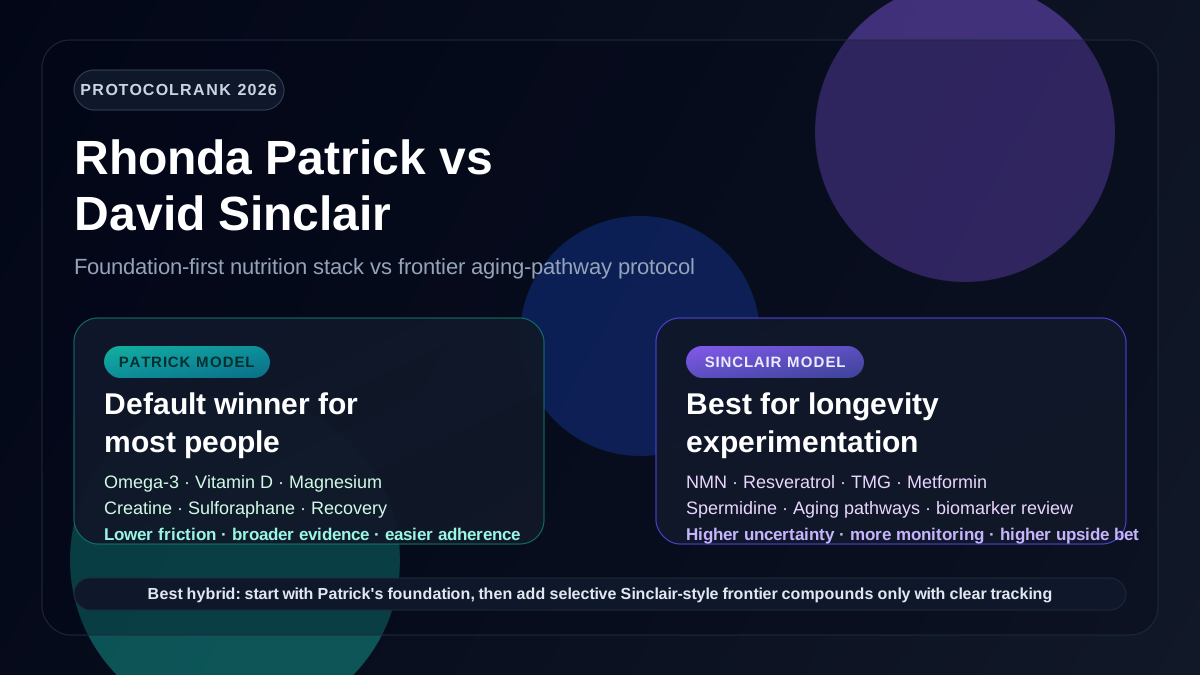
Visual Summary: Foundation vs Frontier
Patrick's stack wins on adherence and default usefulness. Sinclair's stack wins when the goal is exposure to the most credible aging-pathway bets — and the user is prepared to monitor more carefully.
Overview: Two Very Different Versions of “Evidence-Based”
Rhonda Patrick and David Sinclair are often grouped together because both speak the language of science, both focus on longevity, and both have attracted unusually educated audiences compared with the average supplement personality. But they are not running the same playbook. Patrick is best understood as an evidence-dense nutritional optimization researcher whose stack starts from deficiency correction, mechanistic resilience, and broad public-health usefulness. Sinclair is better understood as a longevity frontier researcher whose stack starts from the proposition that aging itself is a treatable biological process and that targeted compounds can slow or partially reverse key hallmarks of aging.
That difference matters because it changes what kind of uncertainty each person is willing to tolerate. Patrick's public recommendations usually cluster around interventions with high safety margins and meaningful human data: omega-3s, vitamin D, magnesium, creatine, exercise, sleep quality, sauna, and sulforaphane-rich foods or supplements. Sinclair is more willing to live at the edge of the evidence map. NMN, resveratrol, metformin, spermidine, and senolytic ideas all fit a coherent molecular-aging thesis, but the direct human longevity-outcome proof for many of these interventions remains incomplete.
In practice, Patrick's model feels like a precision-upgraded version of foundational health. Sinclair's model feels like a translational-research protocol for people who want exposure to the most credible anti-aging hypotheses before medicine has fully standardized them. Both can be intellectually honest. Both can be useful. But they solve different decision problems.
This comparison is therefore less about creating a winner and more about helping readers decide where on the evidence frontier they want to operate. If you want broad upside with relatively low complexity, Patrick's stack is unusually strong. If you want explicit exposure to the most compelling aging-pathway interventions — and you are comfortable with both higher cost and higher uncertainty — Sinclair's protocol becomes more attractive.
The strongest personal protocol for most people will not be a pure copy of either figure. It will usually look like Patrick's high-confidence foundation, with selective Sinclair-style additions only after core biomarkers, recovery behaviors, and budget discipline are already in place.
Stack Architecture: Foundational Resilience vs Aging-Pathway Targeting
Patrick's stack architecture is compact and deliberately foundational. Omega-3s and vitamin D are not included because they sound futuristic; they are included because deficiency or insufficiency is common, the upside is broad, and the human evidence is relatively deep. Magnesium and creatine operate similarly: they cover major physiological systems, solve common modern-world gaps, and have clear implementation pathways. Even Patrick's more distinctive recommendation — sulforaphane — still fits this template because it can be delivered through foods or standardized supplements and has a strong mechanistic case with growing human data.
Sinclair's architecture is far more pathway-specific. NMN aims at restoring NAD+ levels that decline with age. Resveratrol is positioned as a sirtuin-linked compound within the broader cellular stress-response conversation. TMG is layered in to support methylation balance when high-dose NAD+ precursors are used. Metformin enters the stack not as a vitamin-style foundation but as a drug with plausible longevity and metabolic benefits that should be evaluated under a risk-benefit lens. Spermidine and senolytic concepts reflect the same pattern: direct intervention against proposed aging mechanisms rather than broad nutritional coverage.
The result is that Patrick's stack can be thought of as bottom-up longevity: improve the terrain first, make the body harder to break, and use a smaller number of low-friction interventions that produce whole-system resilience. Sinclair's stack is top-down longevity: target the master pathways thought to drive aging, accept that some tools are still in the translational phase, and treat personal use as a rational bet under scientific uncertainty.
This also changes how stack mistakes happen. In a Patrick-style stack, the common mistake is underdosing or choosing low-quality forms — buying weak fish oil, using poorly absorbed magnesium, or assuming any broccoli extract equals sulforaphane exposure. In a Sinclair-style stack, the common mistake is copying frontier compounds without understanding why they are there, what tradeoffs they carry, or what biomarkers would justify continuing them. One is mainly an execution-quality error. The other is often a decision-theory error.
For most readers, the cleanest architecture is to start with Patrick's foundation and add only the Sinclair elements that survive three filters: a defensible mechanistic rationale, acceptable safety and cost, and a clear plan for outcome review after 8 to 12 weeks or the next relevant lab cycle.
Where the Two Protocols Still Overlap
Despite the philosophical divergence, both models still converge on a familiar truth: longevity compounds work best when they sit on top of real behavior quality and not as a substitute for it.
| Category | Patrick — Core Overlap | Sinclair — Core Overlap |
|---|---|---|
| Omega-3 / Fish Oil | A flagship recommendation. Patrick repeatedly treats EPA/DHA sufficiency as one of the highest-return interventions for inflammation, brain health, and cardiovascular protection. | Also compatible with Sinclair's longevity framing, though less central to his public identity than NAD+, resveratrol, or metformin. |
| Vitamin D Status | High priority, usually paired with K2 and guided by serum testing when possible. | Included as a foundational longevity and health-maintenance compound rather than a frontier differentiator. |
| Exercise + Behavioral Foundations | Sleep, exercise, and nutrient-dense food are still higher expected-value than any marginal supplement upgrade. | Intermittent fasting, exercise, and plant-forward diet remain core — the supplement stack is built on top of these behaviors, not instead of them. |
| Inflammation Control | Targets chronic inflammation indirectly through omega-3s, micronutrient sufficiency, sulforaphane, and recovery-supportive lifestyle design. | Targets inflammation both indirectly through lifestyle and more directly through aging-pathway interventions and metabolic signaling compounds. |
| Data Use | Uses biomarkers to refine, but many recommendations still make sense as broadly applicable public-health moves. | Uses biomarkers to justify and individualize much more of the stack, especially when the intervention risk or uncertainty is higher. |
| Long-Horizon Goal | Reduce preventable degeneration and preserve function through consistently executable, lower-risk interventions. | Actively slow biological aging by intervening in the molecular machinery thought to drive aging itself. |
Evidence Threshold: Broad Human Utility vs Frontier Mechanistic Bets
Patrick generally operates with a more conservative evidence posture in public. That does not mean every recommendation is backed by gigantic randomized trials, but it does mean the recommendations usually sit inside domains where the cumulative evidence is directionally strong and the downside is low. Omega-3s, vitamin D optimization, creatine, exercise, and micronutrient sufficiency all meet that bar. Even sulforaphane — more niche than the others — has a persuasive combination of mechanistic coherence and targeted human data in areas like detoxification, inflammation, and cell-protective signaling.
Sinclair's evidence posture is more frontier-forward. His academic work helped shape how the public thinks about NAD+, sirtuins, and the treatability of aging. But translating that conceptual framework into a consumer stack requires accepting a larger gap between mechanism and final clinical proof. NMN has strong scientific interest and meaningful early data, yet long-duration human longevity-outcome evidence is still immature. Resveratrol remains scientifically famous but clinically mixed. Metformin is one of the strongest pieces in his stack, but even there, benefit depends heavily on age, metabolic state, and context.
Importantly, frontier does not mean irrational. It means the confidence interval is wider. Some readers actively want that exposure because they believe the best anti-aging returns come from acting before the literature is fully settled. That can be reasonable if the compounds are chosen carefully and the user is honest about uncertainty. But it should not be confused with the same type of confidence one can place in correcting low vitamin D, improving omega-3 intake, or building a creatine habit.
A useful practical model is to sort both stacks into tiers. Patrick's core foundation sits mostly in a high-confidence tier: strong prior, broad applicability, and generally favorable adherence-adjusted return. Sinclair's stack contains a mix of high-confidence elements at the base — sleep, exercise, diet, vitamin D, perhaps metformin in the right context — and moderate-confidence frontier elements above that. Readers get into trouble when they invert the order and build a frontier stack on top of poor fundamentals.
The highest-value synthesis is therefore not 'Patrick or Sinclair.' It is Patrick for the default layer and Sinclair for optional, explicitly monitored experimentation once the foundation is already performing.
Cost, Monitoring, and Adherence Reality
Patrick-inspired protocols usually win on adherence-adjusted economics. A high-quality fish oil, vitamin D3 plus K2, magnesium glycinate or threonate, creatine monohydrate, and either broccoli sprouts or a credible sulforaphane product can be run at a serious level without turning supplementation into a second job. Most of the value is captured by consistency, good sourcing, and getting the form and dose right.
Sinclair-inspired protocols are more expensive not only because the compounds themselves cost more, but because the logic of the stack pushes you toward more monitoring. If you are using NMN, resveratrol, metformin, TMG, and perhaps periodic longevity-specific testing, it becomes much harder to justify operating without a biomarker review plan. That raises the total protocol cost beyond the price of capsules alone.
Monitoring burden also changes the psychological experience of the stack. Patrick's approach can be run as a durable health routine. Sinclair's approach often becomes a project. For some people that is energizing. For others it quietly lowers long-term compliance because every compound feels like a scientific bet that needs to be watched, interpreted, and defended.
That distinction matters because supplement returns are only real when they persist. A five-compound Patrick-style foundation taken for three years will often outperform a sophisticated Sinclair-style stack that is abandoned after four months because the cost, uncertainty, or testing overhead became too annoying. Adherence is not a soft variable; it is part of the intervention itself.
For most adults, the best cost structure is: build a Patrick-like base, run annual or semiannual lab work, and then reserve a small experimental budget for one or two Sinclair-style adds at a time. That keeps the upside of frontier exposure while protecting the long-run economics of the stack.
Who Each Approach Actually Fits
Patrick is the stronger fit for people who want to be evidence-first without being overly conservative, especially if they prefer supplements that directly support whole-body health rather than hypothetical lifespan extension. Her stack is particularly practical for readers who value brain health, inflammation control, nutrient adequacy, recovery, and sustainable execution over years rather than months.
She is also a particularly important reference point for women because her public supplement content tends to translate more naturally to female audiences than many male biohacker stacks do. Creatine, omega-3s, vitamin D, magnesium, and sulforaphane all map well to real-world female health and longevity goals without requiring an overtly male-centered performance lens.
Sinclair is the stronger fit for readers who are explicitly motivated by aging biology and are willing to tolerate a larger gap between mechanistic promise and definitive human proof. If you read about NAD+ decline, sirtuins, senescent cells, or AMPK and want your stack to directly engage those pathways, Sinclair's framework is much more aligned with that mindset.
He also fits users who do not mind complexity and can keep good records. A frontier stack only becomes rational when the user can answer basic questions about objective response: Did a lab marker improve? Did costs stay acceptable? Did the intervention create side effects or interaction burden? Without those answers, the stack drifts from scientific curiosity into expensive vibe-based supplementation.
The hybrid fit is the broadest one: Patrick for the default stack, Sinclair for carefully selected additions like NMN or spermidine once the basics are already locked in. That hybrid model gives most people a better risk-adjusted result than total allegiance to either camp.
Not Sure Where You Sit on the Evidence Frontier?
Take the ProtocolRank quiz to get a personalized protocol recommendation based on your goals, budget, experience level, and tolerance for experimentation.
Take the Protocol Quiz →Our Verdict
ProtocolRank verdict: Rhonda Patrick has the better default stack for most readers in 2026. Her protocol is more robust to imperfect execution, easier to sustain, and anchored in interventions with stronger adherence-adjusted expected value. If a reader asked for one public figure whose stack they could use as a foundation without overcomplicating their life, Patrick is the safer and usually smarter answer.
David Sinclair becomes compelling once the foundation is already in place and the reader wants calculated exposure to the anti-aging frontier. His stack is not best thought of as a replacement for Patrick's model. It is better thought of as an optional upper layer for science-motivated users who are ready to monitor more carefully and accept wider uncertainty bands.
The practical synthesis is straightforward: start with Patrick's core moves — omega-3, vitamin D calibration, magnesium, creatine, sulforaphane, sleep, exercise, protein adequacy — then selectively borrow from Sinclair only where the rationale is strong enough for your age, health status, budget, and testing habits. That sequence preserves the compounding value of a stable foundation while avoiding premature frontier stacking.
If you want the shortest possible answer, it is this: Patrick is better for default optimization; Sinclair is better for intentional experimentation. Most people should live mostly in Patrick's world and visit Sinclair's world selectively.
For Patrick's standalone stack, see our Rhonda Patrick supplement stack ranked 2026. For Sinclair's contrast with a more systems-engineered biohacker protocol, see our David Sinclair vs Bryan Johnson longevity protocol comparison. For Sinclair-specific compounds, review our best NMN supplements ranked 2026, our best resveratrol supplements, and our best spermidine supplements ranked 2026. For Patrick's foundational layer, review our best omega-3 supplements and creatine protocols ranked.
Rhonda Patrick vs David Sinclair FAQ
Is Rhonda Patrick or David Sinclair better for longevity beginners?
Rhonda Patrick is the better starting point for most longevity beginners. Her stack emphasizes high-confidence, lower-friction interventions like omega-3s, vitamin D, magnesium, creatine, and sulforaphane. Sinclair's protocol is more appropriate once foundational habits and baseline biomarkers are already in place.
What supplements overlap between Rhonda Patrick and David Sinclair?
There is meaningful overlap at the foundation layer: vitamin D support, omega-3 compatibility, exercise, fasting or meal-timing discipline, and broad anti-inflammatory goals. The key difference is emphasis: Patrick centers public-health-style nutritional optimization, while Sinclair centers direct aging-pathway intervention.
Does David Sinclair take more experimental supplements than Rhonda Patrick?
Yes. Sinclair's stack is more frontier-oriented, with compounds like NMN, resveratrol, metformin, spermidine, and senolytic concepts sitting closer to the edge of current human evidence. Patrick's public stack is generally more conservative and population-ready by comparison.
Is Rhonda Patrick's supplement stack cheaper than David Sinclair's?
Usually yes. A serious Patrick-style stack often lands around $80–$180 per month, while a more complete Sinclair-style stack can run $150–$350 per month before adding extra testing or physician-guided elements. Sinclair's model also tends to create more monitoring-related costs.
Who has the stronger evidence base: Rhonda Patrick or David Sinclair?
For day-to-day consumer supplementation, Patrick's stack usually has the stronger evidence-adjusted foundation because it leans more heavily on nutritional sufficiency, creatine, omega-3s, and other broadly validated interventions. Sinclair's framework is scientifically influential but more dependent on mechanistic and emerging evidence where long-term human proof is still developing.
Can I combine Rhonda Patrick's stack with parts of David Sinclair's protocol?
Yes — that is often the best strategy. Build Patrick's foundation first, then add Sinclair-style compounds selectively and one at a time, ideally with a plan for biomarker review, cost control, and honest re-evaluation after a defined trial window.
What is the ProtocolRank recommendation in one sentence?
Use Rhonda Patrick as your default longevity foundation and treat David Sinclair as an optional frontier layer for carefully monitored experimentation.