Longevity Comparison
Bryan Johnson Blueprint vs Peter Attia Longevity Protocol
This guide compares the two most discussed modern longevity systems across practical dimensions that matter: cost, routines, supplement strategy, diagnostic intensity, and long-term sustainability.
Further Reading from Our Sister Sites
Alive Longevity
Alive Longevity: Longevity Supplement Guides
Research-backed supplement explainers and buyer guides for stacking decisions.
Peaked Labs
Peaked Labs: TRT Provider Comparisons
Compare telehealth TRT provider models, monitoring cadence, and total program costs.
Alive Longevity
Alive Longevity: Ingredient Deep Dives
Deep dives on high-interest ingredients like omega-3s, collagen, and magnesium forms.
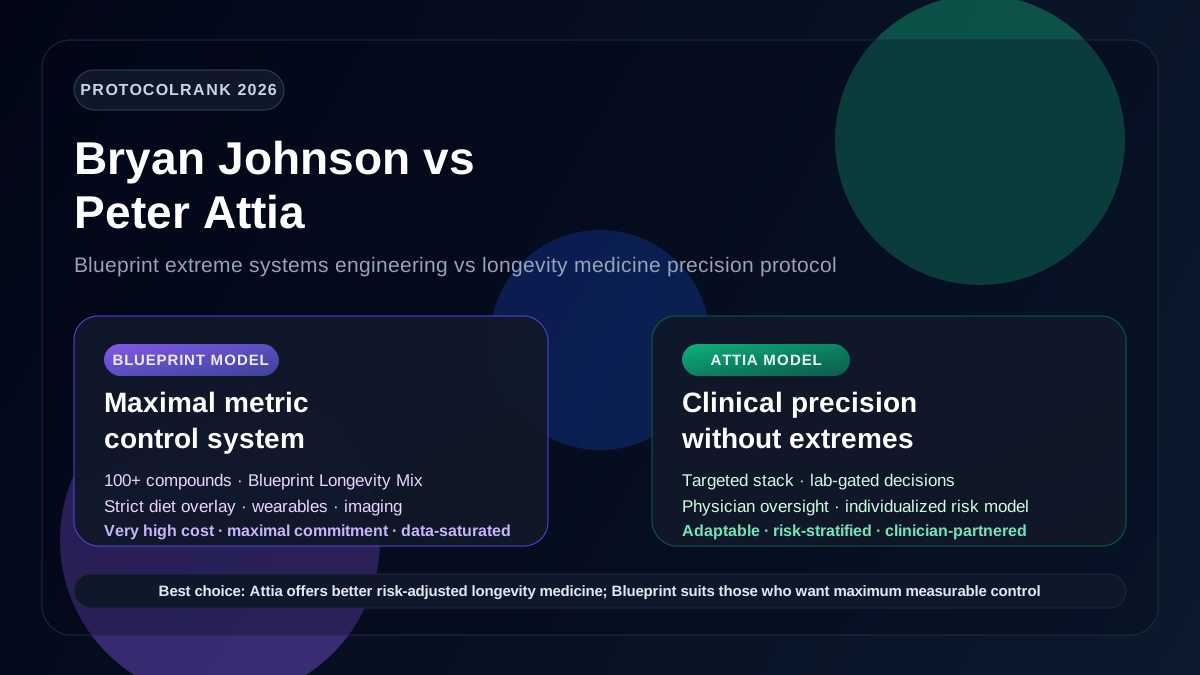
Visual Summary: Blueprint vs Attia
Blueprint optimizes for maximum measurable age control. Attia optimizes for clinical precision and adaptable risk reduction — a significant philosophical difference with real implications for cost and sustainability.
Overview
The phrase ‘bryan johnson blueprint vs peter attia protocol’ often sounds like a head-to-head contest, but the two systems were designed for different implementation realities. Blueprint is an extreme standardization model where the day is engineered to reduce biological drift and maximize measurable control. Attia’s protocol is a clinician-influenced longevity strategy that emphasizes long-term risk reduction, fitness capacity, and personalized decision-making informed by medical history and objective testing.
Bryan Johnson’s Blueprint became widely known because it publishes an unusually detailed public routine: tightly structured meal timing, significant supplement usage, strict sleep schedule, frequent biomarker tracking, and aggressive attention to measurable outcomes. Blueprint is not just a list of habits; it is a systems-engineering project applied to human biology. The core assumption is that high-frequency data plus consistent execution can reduce physiological decline and improve long-term health trajectory.
Peter Attia’s longevity framework is less rigidly templated but no less serious. It typically prioritizes exercise capacity, cardiometabolic risk management, sleep quality, nutritional adequacy, and proactive diagnostics, while incorporating medical interventions when justified. Attia’s public communication repeatedly highlights the concept of preventing chronic disease through earlier and more granular action than conventional reactive medicine. The strategy focuses heavily on cardiovascular risk, metabolic function, and preserving physical capability into later decades.
At a behavioral level, Blueprint is more ‘operating system,’ while Attia is more ‘decision framework.’ Blueprint tells you what to do almost minute by minute. Attia gives you principles, test categories, and performance targets, then expects adaptation based on your baseline, physician partnership, and life constraints. This distinction matters because many users fail not from lack of motivation but from mismatch between protocol architecture and their available time, budget, and cognitive bandwidth.
The most useful way to compare these systems is by decision criteria: implementation burden, expected benefit, data dependency, cost, and resilience during disruption. If your schedule is volatile or your budget is finite, protocol design quality is not just about ambition; it is about survivability. A protocol that is 95% optimal in theory but 30% executable in your real life loses to a protocol that is 80% optimal and 80% executable.
From a research perspective, both frameworks borrow from established pillars: exercise as a dominant predictor of long-term health, sleep regularity, nutrition quality, and risk-factor control. Where they diverge is intensity and granularity. Blueprint attempts maximal control through volume of interventions. Attia attempts maximal relevance through prioritization and risk-adjusted strategy. Neither should be interpreted as a universal template without adaptation to individual medical context.
| Category | Blueprint | Attia Protocol |
|---|---|---|
| Core Goal | Aggressive, metric-saturated whole-body age-slowing system. | Risk-reduction and lifespan extension through medicine-plus-lifestyle optimization. |
| Operating Style | Highly standardized routine with strict daily repetition. | Principles-based framework adapted to individual context and clinician input. |
| Testing Intensity | Very high frequency biomarker and imaging emphasis. | Moderate to high, prioritized by risk profile and physician-guided decisions. |
| Supplement Load | High-volume stack and precise meal/supplement timing. | Targeted supplementation secondary to training, sleep, nutrition, and medication decisions. |
| Exercise Focus | Structured fitness with broad performance and body composition metrics. | Heavy focus on VO2 max, strength, stability, and exercise as medicine. |
| Complexity | Very high operational overhead. | High conceptual load but can be simplified for real-life adherence. |
| Estimated Monthly Cost Range | Often very high depending on testing and product choices. | Moderate to very high depending on concierge medicine, imaging, and lab strategy. |
| Best Fit | Optimization maximalists with budget and schedule control. | Professionals seeking evidence-based longevity strategy with medical context. |
Cost Comparison
Cost is where the contrast becomes obvious. Blueprint-style execution can involve substantial recurring spending on supplements, specialty foods, frequent laboratory panels, advanced diagnostics, and potential device subscriptions. Even when users simplify the plan, the default direction remains high expense because the protocol assumes frequent measurement and broad intervention coverage. For most people, the gap between ‘Blueprint in full’ and ‘Blueprint inspired’ is primarily a budget issue.
Attia-style execution can range from moderate to extremely expensive depending on how far you go with concierge medicine, imaging, specialist consultations, and testing cadence. The key difference is optionality. Attia’s model is easier to run in tiers: a lower-cost foundation with exercise, sleep, nutrition, and standard labs, then step up to advanced testing or pharmacology as risk profile and budget justify. Blueprint can also be tiered, but culturally it is associated with maximal implementation.
In our cost scoring model, we separate fixed costs from variable costs. Fixed costs include core habits that are low-cost or no-cost: walking, sleep schedule, resistance training basics, and improved dietary structure. Variable costs include premium supplements, high-frequency bloodwork, imaging, and clinician time. Blueprint typically has both higher fixed complexity and higher variable cost. Attia can maintain lower fixed complexity while allowing variable cost escalation only where expected value is high.
A common error is spending heavily before stabilizing low-cost fundamentals. Many users buy advanced panels and long supplement stacks while still sleeping irregularly and training inconsistently. Both Johnson and Attia would likely agree this sequence is backwards. In practical terms, the highest return on healthspan dollars usually comes from high-adherence basics first, then targeted diagnostics and interventions once behavior stability is established.
Another cost dimension is opportunity cost. Blueprint-level complexity can consume planning time, shopping time, prep time, and mental overhead. For founders, clinicians, parents, and shift workers, this hidden cost can be larger than the invoice cost. Attia-style protocols can also become time-intensive, but they are easier to compress into high-yield weekly blocks because they are principles-led rather than universally scripted.
If you want a defensible starting budget, build a tiered plan. Tier 1: sleep consistency, structured training, nutrition quality, and standard preventive labs. Tier 2: targeted supplements based on documented gaps and goals. Tier 3: advanced diagnostics and specialist support for unresolved issues or elevated risk. This tiering approach maps more naturally to Attia’s framework but can be used to adapt Blueprint into a sustainable model.
Daily Routine Comparison
Daily routine design determines whether a protocol becomes a lifestyle or a short-term project. The table below captures operational differences, followed by implementation notes.
| Category | Blueprint Routine | Attia-Inspired Routine |
|---|---|---|
| Morning | Highly scheduled start with fixed wake time, biomarker-aware choices, and preplanned meals/supplements. | Focus on training, protein strategy, and circadian-aligned wake routine tailored to schedule. |
| Nutrition Pattern | Standardized meal composition and timing with narrow variance. | Protein-centric, quality-focused eating with flexible structure and individualized strategy. |
| Training | Structured sessions integrated into a larger quantified system. | Heavy emphasis on zone 2 aerobic work, VO2 max efforts, strength, and stability across the week. |
| Workday Integration | Routine takes priority; work and social life adapt to protocol where possible. | Protocol adapts to work and life demands while preserving critical health anchors. |
| Evening | Strict wind-down and sleep schedule with strong environmental control. | Consistent sleep protection, less scripted but still deliberate and prioritized. |
| Data Review | Frequent and broad review of multi-domain metrics. | Selective review linked to risk priorities and long-term trends. |
Blueprint’s daily routine is engineered for repeatability. Meals are often highly standardized, supplements are timed, and decisions are pre-made to reduce variability. This can dramatically lower decision fatigue for some users, but it can feel restrictive for others. The protocol assumes that consistency is easiest when choices are minimized and routines are automated.
Attia’s daily pattern is better described as performance architecture rather than strict script. The framework often includes defined training priorities across aerobic base, high-intensity capacity, strength, and movement quality. Nutrition is treated as a tool for metabolic health and body composition, not a universal meal blueprint. Sleep remains central, but the routine is usually integrated into work and family realities rather than requiring the environment to fully revolve around the protocol.
On adherence data from coaching and behavior-change literature, strict systems can produce strong short-term improvements but higher dropout risk when life gets chaotic. Flexible principles systems may improve more slowly at first yet maintain better long-horizon consistency. This is one reason why many users start with Blueprint enthusiasm, then gradually converge toward an Attia-like prioritization model that protects key levers while reducing total protocol load.
For people who thrive on structure, Blueprint can feel liberating because it removes ambiguity. For people who value autonomy and variation, it can feel oppressive. Attia’s model requires more judgment but usually less day-to-day rigidity. The best indicator of fit is not motivation level alone; it is whether your personality and schedule can sustain the routine when stress, travel, and social obligations spike.
An underrated point is family and social compatibility. Blueprint-level standardization can create friction in shared meals, travel plans, and late events. Attia-style implementation can still be demanding, especially with training volume, but it is generally easier to negotiate in household contexts because it leaves more room for choice and adaptation.
If your primary challenge is inconsistency, a temporary Blueprint-inspired block can help reset behavior. If your primary challenge is long-term sustainability, an Attia-inspired structure usually scales better. Many high performers use a cyclical model: periods of strict execution followed by stable maintenance mode with fewer constraints and preserved core outcomes.
Supplement Stacks
Supplement strategy is one of the most visible differences between these protocols. Blueprint is associated with a large and explicit stack, often including broad micronutrient support, compounds targeting inflammation and metabolic pathways, and highly specific timing. The appeal is obvious: supplements offer concrete action and measurable ritual. The risk is equally obvious: stack size increases cost, interaction complexity, and uncertainty about which component drives outcomes.
Attia’s public framing is comparatively selective. Supplements can be useful, but they are generally downstream of training, sleep, diet quality, and medical evaluation. In this model, supplementation is targeted to a documented need, plausible mechanism, or risk-adjusted objective. This tends to reduce stack bloat and improve interpretability because fewer simultaneous variables are changing.
From an evidence standpoint, supplement quality varies dramatically by compound, dose, baseline status, and endpoint. Some interventions show stronger data in deficiency states or specific populations than in broadly healthy adults. For decision quality, the key principle is to avoid mistaking ‘can influence a biomarker’ for ‘meaningfully improves long-term outcomes in your context.’ Outcome relevance matters more than novelty.
A practical method for either protocol is staged testing. Add one supplement at a time, define target outcomes in advance, and set a clear review window. If no meaningful signal appears, stop. This approach prevents ever-growing stacks that persist mostly because they feel proactive. It also aligns with scientific reasoning: isolate variables, measure change, and avoid confounding.
Safety is not optional. Multi-compound stacks can interact with medications, alter lab interpretation, or produce side effects that mimic unrelated issues. Anyone implementing a high-volume stack should coordinate with a qualified clinician and use reliable product sourcing. High adherence to weak interventions is still weak strategy; quality of intervention selection remains the main determinant of return.
In ProtocolRank scoring, supplement intensity is not automatically rewarded. We score expected value per unit burden. Targeted, evidence-aware supplementation with high adherence and good monitoring can score very well. Large stacks without clear objective linkage usually score lower despite appearing sophisticated.
Key Differences
Difference one is optimization philosophy. Blueprint attempts maximal control by reducing variability and increasing intervention density. Attia aims for maximal relevance by choosing high-impact levers and adapting intensity to risk profile. The first asks, ‘How much can we control?’ The second asks, ‘Which controls matter most for this person right now?’
Difference two is medical integration style. Blueprint is self-quantification heavy and can include physician support, but the public identity centers on system engineering. Attia’s protocol is explicitly physician-informed and grounded in preventive medicine logic, especially around cardiovascular risk, metabolic markers, and early intervention decisions.
Difference three is training centrality. Both value exercise, but Attia places exceptional focus on aerobic capacity and strength as primary longevity drivers, with practical programming around zone 2, VO2 max work, and resistance training. Blueprint includes fitness, but its public narrative often emphasizes total-system biomarker control rather than exercise-first framing.
Difference four is failure mode. Blueprint fails when complexity overwhelms adherence. Attia fails when abstraction leads to inconsistent execution or analysis paralysis. Each failure mode suggests its own fix: simplify Blueprint into tiers, or concretize Attia with explicit weekly templates and accountability.
Difference five is social legibility. Attia’s recommendations can be integrated into mainstream healthy living with moderate explanation. Blueprint often appears extreme to peers, which can reduce social support and increase dropout probability. This social factor is rarely discussed, yet it strongly influences long-term adherence in non-isolated environments.
Who Each Protocol Is Best For
Blueprint is best for users with high control over schedule, strong tolerance for routine repetition, substantial budget flexibility, and genuine interest in measurement-heavy self-experimentation. If you want a high-definition protocol and enjoy operating from detailed playbooks, Blueprint can be compelling.
Attia’s framework is best for users who want evidence-aligned longevity strategy that can evolve with life stage, clinical data, and competing responsibilities. It suits professionals who value high-impact fundamentals and targeted diagnostics more than maximal daily standardization.
A hybrid approach works for many people: borrow Blueprint’s discipline around consistency and objective tracking cadence, then apply Attia’s prioritization lens to reduce unnecessary interventions. This gives structure without overextending complexity budget.
Users with chronic health conditions, medication use, or elevated cardiovascular risk should prioritize medical supervision and risk-stratified planning. In these contexts, Attia-style clinical integration generally provides a safer architecture than independent stack expansion.
Users pursuing aesthetic or performance goals alongside longevity can still use either framework, but they should set explicit primary outcomes. Protocol confusion often starts when multiple goals are blended without rank order. A clear goal hierarchy improves intervention selection and review decisions.
If uncertainty remains, run a 12-week pilot. Weeks 1 to 4: establish sleep and training consistency. Weeks 5 to 8: add targeted nutrition and selective supplementation. Weeks 9 to 12: review metrics, adherence, and cost. Choose the framework that delivers better adherence-adjusted outcomes, not the one that sounds more advanced online.
Evidence Notes
Based on available research, longevity outcomes are most strongly influenced by long-term behavior consistency, fitness capacity, cardiometabolic risk control, and sleep quality. Protocol sophistication is useful only when it improves adherence-adjusted outcomes.
- • Higher cardiorespiratory fitness and muscular strength are repeatedly associated with lower all-cause mortality and better functional aging outcomes.
- • Sleep duration and regularity influence metabolic, cognitive, and cardiovascular risk pathways relevant to longevity planning.
- • Metabolic health markers, blood pressure, lipids, and inflammation indicators are useful when interpreted in context and tracked over time.
- • Behavioral consistency is a dominant predictor of long-term health outcomes; intervention complexity can erode adherence when not matched to user capacity.
- • Personalized risk-based medicine often outperforms one-size-fits-all protocols for individuals with specific risk factors or clinical history.
Our Verdict
ProtocolRank’s verdict: Blueprint is the most complete public example of high-intensity longevity standardization, while Attia provides the more transferable framework for long-term real-world use. Blueprint can produce impressive structure and measurable control in highly resourced environments. Attia’s model is usually better for sustained behavior under normal life constraints.
If your immediate objective is a strict reset and you can sustain high operational burden, Blueprint-inspired execution can be powerful for a fixed period. If your objective is a durable, decade-scale protocol that integrates with career and family demands, Attia’s prioritization approach is the safer default.
The highest expected return for most readers is a staged hybrid: Attia fundamentals as the base, Blueprint precision layers where evidence and personal response justify the added burden. This keeps the protocol serious without becoming brittle.
Decision rule: choose the system you can execute at least 80% of the time for years, not the system that looks most optimized for one month. Adherence-weighted outcomes beat theoretical perfection.
If sleep quality is your bottleneck, use our deep comparison of Huberman vs Matthew Walker sleep protocols. For nutrition timing decisions, review our ranking of intermittent fasting protocols. To see how Peter Attia's protocol compares specifically to Huberman's supplement approach, see our Huberman vs Attia supplement comparison. For how David Sinclair's academic longevity science stacks up against Johnson's Blueprint engineering, see our Sinclair vs Johnson longevity protocol comparison.
Blueprint vs Attia FAQ
Is Bryan Johnson Blueprint more effective than Peter Attia's protocol?
Blueprint can be highly effective for users who can sustain extreme structure and cost. Attia's framework is usually more sustainable and clinically adaptable for long-term execution. Effectiveness depends on adherence-adjusted fit.
Which protocol is more expensive?
Blueprint is generally more expensive at full implementation due to high supplement and testing intensity. Attia can also be expensive, but it is easier to run in budget tiers with prioritized interventions.
Do I need advanced diagnostics to follow either protocol?
Not initially. Most people should first lock in sleep, training, and nutrition consistency, then add diagnostics when they will change decisions or when risk profile justifies deeper testing.
Can I combine Blueprint and Attia approaches?
Yes. A common strategy is Attia-style fundamentals plus selective Blueprint structure for routines and measurement cadence. This hybrid often improves sustainability while keeping rigor.
How should beginners start a longevity protocol?
Start with a 12-week base phase: consistent sleep schedule, structured exercise split, protein-aware nutrition, and baseline labs. Expand only after adherence is stable and goals are clearly defined.