Supplement Comparison
Andrew Huberman Supplements vs Bryan Johnson Blueprint Supplements
This guide compares two high-visibility supplement ecosystems across what matters most in practice: stack design, evidence confidence, cost, overlap, adherence burden, and outcome reliability.
Further Reading from Our Sister Sites
Alive Longevity
Alive Longevity: Longevity Supplement Guides
Research-backed supplement explainers and buyer guides for stacking decisions.
Peaked Labs
Peaked Labs: TRT Provider Comparisons
Compare telehealth TRT provider models, monitoring cadence, and total program costs.
Alive Longevity
Alive Longevity: Ingredient Deep Dives
Deep dives on high-interest ingredients like omega-3s, collagen, and magnesium forms.
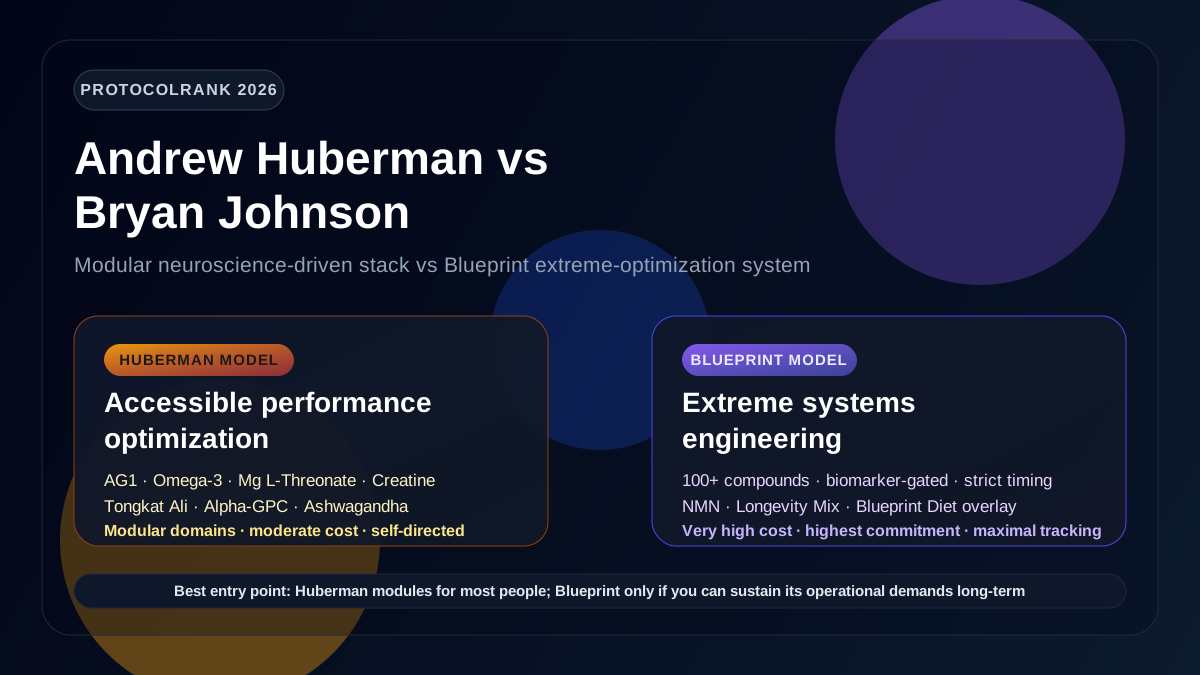
Visual Summary: Modular vs Systems Engineering
Huberman's approach lets you pick the modules that match your goals. Johnson's Blueprint demands full-system adoption — a fundamentally different operational commitment.
Executive Comparison Table
| Category | Huberman-Style Stack | Blueprint Stack |
|---|---|---|
| Primary Goal | Support sleep, cognition, stress management, and performance with modular optional stacks. | Engineer a comprehensive longevity system with broad, high-volume daily supplementation. |
| Stack Style | Topic-based modules that can be run independently. | Large integrated stack designed to operate as one full system. |
| Complexity | Moderate if simplified; high if many modules are combined. | Very high daily operational and organizational complexity. |
| Estimated Monthly Cost | Low to moderate when using selective compounds only. | Moderate to very high depending on full stack adherence and sourcing. |
| Evidence Profile | Mixed by compound, with emphasis on practical behavior plus optional supplementation. | Mixed by compound, broader stack breadth increases uncertainty and confounding. |
| Best Fit | Users seeking targeted, flexible experiments around specific outcomes. | Optimization maximalists with budget, structure, and tracking discipline. |
| Main Risk | Cherry-picking trends without stable foundations or dose logic. | Stack overload, cost escalation, and unclear attribution of benefits or side effects. |
Overview and Decision Framing
The search term 'andrew huberman supplements vs bryan johnson blueprint supplements' usually hides a deeper decision: do you want a modular supplement toolkit or a full-system stack that tries to control many biological variables at once? Both approaches can look evidence-driven online, but they operate with different assumptions about behavior, budget, and daily friction. Choosing correctly depends less on influencer preference and more on whether your routine can support the architecture you pick.
Huberman-style supplementation is generally presented as optional layering around behavior fundamentals. Light timing, sleep regularity, exercise, and nutrition quality are often framed as non-negotiable base drivers, while compounds are positioned as situational tools. In practice, this means users can adopt a narrow subset for a clear goal, such as sleep onset or stress regulation, without committing to an all-day protocol with heavy inventory management.
Bryan Johnson's Blueprint identity is different. The stack is part of a tightly engineered system that combines supplementation, food structure, testing cadence, and lifestyle constraints. The value proposition is comprehensive control through consistency and measurement. The tradeoff is implementation load. Even users inspired by Blueprint typically run a simplified version because the full model demands unusual schedule control and high tolerance for routine repetition.
A direct compound-by-compound comparison is less useful than comparing protocol logic. Huberman-style stacks are easier to deploy as short experiments and easier to remove when no signal appears. Blueprint-style stacks can produce stronger perceived structure and ritual commitment, but they create attribution problems because many compounds and behaviors shift simultaneously. This matters when side effects appear or costs rise and users need to know what to change first.
For practical decision-making, think in three layers. Layer one is foundation: sleep, exercise, protein adequacy, alcohol control, and circadian timing. Layer two is targeted supplementation for known gaps or high-probability needs. Layer three is broad stack expansion. Most users should not start at layer three. Doing so often inflates cost and complexity before core behavior consistency is established, reducing net benefit despite higher effort.
This comparison ranks neither stack as universally superior. Instead, it maps where each is likely to work, where each fails, and how to adapt either model into a high-return personal protocol. If your goal is durable outcomes over years, architecture quality and adherence probability will matter more than stack size.
Stack Architecture: Modular vs System-Wide
Huberman-linked supplement discussions are commonly organized by outcome domains: sleep, focus, stress, training recovery, and general health. This modular design lowers adoption friction because users can pick one domain and test it without rebuilding their entire day. The downside is that modularity can still turn into stack sprawl when users add multiple domains at once without stop rules or tracking discipline.
Blueprint supplement design is system-first rather than module-first. Compounds are embedded in a larger protocol meant to reduce variability and support broad longevity goals. This can feel efficient for users who prefer pre-defined routines and high structure. However, system-first design raises the burden of logistics: sourcing, timing, travel execution, refill management, and interpreting biomarker changes with many moving parts.
A practical difference is decision cadence. In modular models, decisions are frequent but small. You test, keep, or remove compounds in short cycles. In system-heavy models, decisions are less frequent but larger, because changing one component may impact many assumptions in the overall stack. Both can work, but the failure modes differ. Modular stacks fail through drift and inconsistency. System stacks fail through overload and rigidity.
Another design difference is tolerance for uncertainty. Huberman-style experiments often accept incremental uncertainty in exchange for flexibility. Blueprint-style systems attempt to reduce uncertainty through high data density, but this can paradoxically create new ambiguity when too many variables are changed together. More data does not always equal clearer decisions if intervention design remains highly confounded.
From a coaching perspective, modular designs are easier to personalize for constrained lifestyles. Shift workers, parents, and frequent travelers can keep a minimal stack and preserve critical habits. Blueprint-inspired designs are more successful when users control meal timing, sleep timing, and daily schedule with high precision. Without that control, perceived complexity can outpace actual benefit.
The core takeaway is not that one architecture is better in theory. It is that architecture must match context. If your life is already highly structured and you enjoy systems management, Blueprint-style stacking may feel natural. If your schedule is variable, modular supplementation with strict prioritization usually produces better adherence-adjusted return.
Overlap and Divergence in Practice
Both approaches share some broad categories, but they differ in density, operational discipline, and how decisions are made when outcomes are unclear.
| Category | Huberman Overlap | Blueprint Overlap |
|---|---|---|
| Sleep-Relevant Compounds | Often includes magnesium, apigenin, and theanine as optional tools. | Sleep support appears inside a larger all-day stack and schedule architecture. |
| Omega-3 / Foundational Lipids | Frequently recommended as part of basic health and cognition support. | Typically included as one component of a broad longevity stack. |
| Polyphenols / Antioxidants | Discussed selectively with context and variable intensity. | Often represented more extensively through high-volume stack design. |
| Electrolytes / Minerals | Positioned as context-dependent support based on training and diet. | Integrated into comprehensive daily regimen planning. |
| Experiment Philosophy | One-variable-at-a-time testing is often emphasized by practitioners. | System-level adoption can make one-variable attribution difficult. |
| Daily Pill Burden | Moderate when selective, high when multiple modules are stacked. | High by default with significant routine discipline required. |
Evidence Quality and Expected Return
Evidence quality in both ecosystems is compound-specific, not brand-specific. Some compounds have reasonable support for selected endpoints, while others rely on preliminary or indirect findings. Users often make the mistake of transferring confidence from one well-supported compound to the entire stack. This creates a false sense of certainty and can lead to unnecessary expansion before meaningful outcomes are observed.
In Huberman-style workflows, evidence interpretation typically pairs mechanistic rationale with practical behavior sequencing. This can be useful when communicated with uncertainty boundaries, but audiences sometimes flatten nuance into simplistic rules. A compound that may help in one context can be neutral or counterproductive in another depending on dose timing, sleep status, and concurrent stimulant use.
Blueprint's broad stack invites a different evidence challenge: cumulative plausibility vs cumulative proof. Each ingredient may have a plausible role, yet the fully combined stack rarely has direct trial-level evidence as a package. That means users are making a systems bet rather than a compound-specific evidence bet. Systems bets can still work, but they require clear metrics and readiness to simplify when returns diminish.
A defensible approach for either model is expected-value scoring. Ask: what is the likely magnitude of benefit, the certainty of evidence, the side-effect probability, and the burden cost? Compounds with low expected benefit and high complexity should not survive protocol pruning. This rule sounds obvious, but stack enthusiasm frequently overrides it.
Another key evidence point is baseline dependency. Supplements that appear effective in deficiency states may have modest impact in already optimized users. Conversely, people with poor sleep or nutritional gaps may experience large gains from simple interventions. High-performing protocols account for this by running baseline assessments and setting context-aware expectations.
Finally, evidence should be linked to meaningful outcomes, not only biomarker movement. If a supplement shifts a lab marker but does not improve daily energy, focus reliability, training quality, or long-term risk profile, its real value may be limited. Outcome relevance is the best filter for both Huberman-inspired and Blueprint-inspired stacks.
Cost, Burden, and Adherence
Cost comparison between these approaches is not only about invoice totals. It includes opportunity cost, planning overhead, and cognitive load. Huberman-style selective stacks can be inexpensive when users limit compounds to high-yield categories. Costs rise quickly when users import multiple domains simultaneously and keep low-signal products out of habit.
Blueprint-inspired implementation often carries higher recurring costs due to stack breadth and premium sourcing expectations. There is also larger operational overhead: organizing capsules, coordinating timing windows, managing subscriptions, and adapting routines during travel. For some users this structure enhances adherence; for others it becomes a hidden tax that reduces long-term consistency.
Adherence burden is where many protocols fail. People often overestimate their tolerance for multi-step routines after reading a compelling case study. The first four weeks can feel manageable, but complexity debt appears later when work pressure, family obligations, or illness interrupts routine continuity. Simpler stacks recover from disruption faster than dense systems with many dependencies.
One useful strategy is budget tiering. Tier 1: foundational nutrition plus one or two compounds with strong personal rationale. Tier 2: add targeted compounds for a specific objective after clear signal from Tier 1. Tier 3: only if needed, test broader stack components with strict stop rules. This sequence preserves optionality and limits sunk-cost bias.
Another strategy is cycle design. Instead of permanent stack inflation, run focused eight- to twelve-week blocks with predefined review points. If no meaningful benefit appears, de-load the stack. Both Huberman-inspired and Blueprint-inspired users benefit from this rhythm because it reduces passive accumulation of low-value supplements.
In most real-world cases, the winning protocol is the one you can execute consistently at reasonable cost for a year. A medium-intensity stack with high adherence often beats a maximal stack that is abandoned after two months. Cost-adjusted consistency is therefore a central ranking variable, not an afterthought.
Who Each Approach Is Best For
Choose a Huberman-style approach if you want flexibility, clear domain-based experimentation, and lower entry complexity. This model suits people who prefer decision agility and are willing to track one variable at a time. It is particularly useful for users with volatile schedules because modules can be scaled up or down without collapsing the entire protocol.
Choose a Blueprint-style approach if you thrive under strict routines, have high budget tolerance, and want a full-system project rather than a targeted experiment. This model can drive strong consistency for users who enjoy operating from pre-committed routines with heavy structure. It is less forgiving when life unpredictability is high.
A hybrid strategy is often optimal. Use Huberman-style prioritization to choose high-yield compounds, then borrow Blueprint-style operational discipline for timing and consistency. This captures most of the structure benefit without requiring maximal stack breadth.
Beginners should avoid social-media mimicry. Start with foundational behavior repair and a short list of compounds tied to explicit outcomes. If the protocol improves sleep continuity, focus reliability, or recovery markers, expand carefully. If it does not, simplify first before adding anything new.
Users with medical conditions, medication use, or history of supplement sensitivity should prioritize clinician oversight and conservative dosing. High-volume stacks increase interaction complexity and can complicate lab interpretation. Personalization and monitoring are especially important in these populations.
The decision rule is straightforward: optimize for adherence-weighted outcome, not stack aesthetics. A protocol that improves real function at acceptable burden is a good protocol, whether it uses three compounds or thirty.
Our Verdict
ProtocolRank verdict: Huberman-style modular supplementation wins for most readers because it is easier to personalize, easier to audit, and easier to sustain under normal life constraints. Blueprint-style supplementation remains valuable for a narrower segment that can support high structure, high cost, and high operational overhead without adherence collapse.
If your current challenge is inconsistency, build a minimal modular stack around one objective and run it for twelve weeks with clean tracking. If your challenge is under-structure and you perform best with strict systems, a simplified Blueprint-inspired routine can be effective when budgets and schedules allow.
The highest-probability strategy is hybridization: keep a small high-confidence stack, tie each compound to a specific objective, and apply rigorous operational discipline borrowed from system-first frameworks. This prevents stack inflation while preserving routine quality.
For adjacent protocol decisions, compare sleep frameworks in our analysis of Huberman vs Walker sleep approaches and evaluate broader longevity architecture in our Blueprint vs Peter Attia comparison.
For sleep-focused protocol selection, review our comparison of Huberman vs Matthew Walker sleep protocols. For full-system longevity architecture, see our Blueprint vs Peter Attia analysis. To compare Huberman directly against Peter Attia's evidence-first approach, see our Huberman vs Attia supplement stack comparison. For the scientist perspective on Bryan Johnson's approach, see our David Sinclair vs Bryan Johnson longevity protocol comparison.
Huberman vs Blueprint Supplements FAQ
Is Andrew Huberman's supplement stack better than Bryan Johnson's Blueprint stack?
For most users, a modular Huberman-style stack is easier to sustain and personalize. Blueprint-style full-stack protocols can work well for users with high structure and budget tolerance.
Which stack is more expensive?
Blueprint-inspired full implementation is usually more expensive due to broader stack scope and operational demands. Costs vary widely based on how simplified the protocol is.
How do I avoid taking too many supplements?
Use a tiered strategy: start with a minimal stack tied to explicit outcomes, add one variable at a time, and remove compounds that do not produce clear benefit within a defined review window.
Do both approaches require lab testing?
Lab testing is not always mandatory for basic supplementation, but it becomes increasingly important as stack complexity grows or when hormonal and metabolic pathways are targeted.
Can I combine the two approaches?
Yes. Many users do best with Huberman-style prioritization and Blueprint-style consistency systems, creating a focused and sustainable hybrid.
What is the biggest mistake people make with either stack?
The most common mistake is adding compounds faster than they can evaluate results, which creates confounding and escalating cost without clear functional improvements.